

Your heels feel like sandpaper. You hide your feet in socks all summer. You have tried six creams and none of them worked.
Kerasal Intensive Foot Repair promises something bold. The brand says you will see visible results in one day. That is a big claim for a small tube that costs less than a fast food lunch.
So I dug into the formula, the clinical numbers, the Amazon reviews, and the real user stories. This Kerasal Intensive Foot Repair review 2026 breaks down what the ointment does, who it helps most, and where it falls short.
You will learn the exact ingredients, the right way to apply it, and how it stacks up against O’Keeffe’s, Eucerin, and strong urea creams. You will also see the honest complaints that most reviews skip.
In a Nutshell
- The formula pairs 20 percent urea with salicylic acid. Urea softens thick, hard skin. Salicylic acid loosens dead cells on top. Together they smooth rough heels instead of just coating them.
- The brand reports fast results. Kerasal states that over 90 percent of people in a clinical study saw improvement after one use, and 93 percent said their feet felt more hydrated after one use.
- Amazon shoppers back the hype. The 1 ounce tube holds a 4.5 star rating across more than 52,000 reviews, and it carries an Amazon’s Choice badge.
- A pea sized amount goes far. The tube is small at 1 ounce, yet most users report it lasting several weeks because the ointment is thick and rich.
- The feel is heavy and greasy on purpose. This is an ointment, not a light lotion. Night use with socks works best, and that texture is the main complaint from buyers.
- It is a treatment, not a daily lotion. Use it for a few weeks to repair damage, then switch to a lighter cream for upkeep.
What Is Kerasal Intensive Foot Repair
Kerasal Intensive Foot Repair is an ointment made for dry, rough, cracked feet. The product comes in a small 1 ounce tube with a pointed cap that punctures the seal.
The texture is thick and waxy. It looks like petroleum jelly, and that is no accident. White petrolatum sits at the top of the ingredient list because it seals moisture into the skin.
The brand markets this product as a repair treatment. It targets hard calluses, thick heel skin, and deep cracks. The package claims visible results in one day.
The ointment holds approval from the American Podiatric Medical Association. That group reviews foot care products and backs the ones with real clinical support. The APMA seal gives this tube extra credibility among foot doctors.
Kerasal also sells a nighttime version and a combo pack with gel socks. The core formula stays the same across most versions. Only the packaging and extras change.
The product suits people with stubborn heel damage. It also helps with rough skin on toes and the sides of the feet. Some users even apply it to dry elbows and hands.
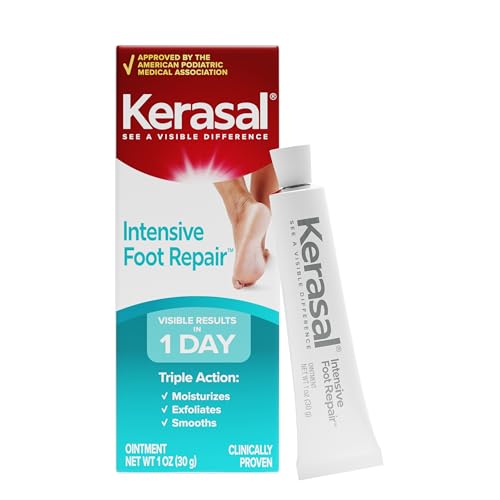
- 1 ounce package of Kerasal Intensive Foot Repair Skin Healing Ointment
- Dry skin ointment designed to help heal cracked heels and dry feet, delivering visible results in just 1 day
- Cracked feet repair has a unique combination of exfoliating, softening and moisturizing ingredients, including salicylic acid (5%), urea (10%) and...

Last update on 2026-10-08 / Affiliate links / Images from Amazon Product Advertising API
Why Cracked Heels Happen in the First Place
Cracked heels start with pressure and dryness. The skin on your heel is thick because it carries your body weight all day. That thick skin loses elasticity when it dries out.
Once the skin loses stretch, it splits under pressure. Small cracks form first. Deep cracks can bleed and hurt when you walk.
Several daily habits make the problem worse. Standing on hard floors for hours adds stress. Open back shoes let the heel fat pad spread outward. That spreading pulls the skin apart.
Dry air steals moisture too. Winter weather, indoor heating, and long hot showers all strip oils from your skin. Age plays a role as well, since skin holds less water over time.
Medical conditions can also drive the problem. Diabetes, thyroid issues, and poor circulation all affect skin health. People with these conditions should talk to a doctor before self treating deep cracks.
Knowing the cause helps you pick the right fix. A simple dry skin case often responds to urea and salicylic acid. A medical case may need a podiatrist.
The good news is that most mild to medium cases improve with a consistent routine. Repair takes weeks, not hours, even with a strong product.
Kerasal Intensive Foot Repair Ingredients Breakdown
The ingredient list is short and focused. The full lineup includes white petrolatum, PEG 8, glycerin, urea, PEG 40 sorbitan peroleate, salicylic acid, PEG 40 stearate, and polysorbate 80.
White petrolatum is the base. It creates a barrier on the skin surface. That barrier stops water from escaping, so the skin can rehydrate itself.
Urea is the star player. Kerasal uses a 20 percent strength, which counts as a high dose for a consumer product. Urea pulls water into the skin and breaks down hard keratin. That dual action softens calluses from the inside.
Salicylic acid handles the surface. This acid loosens the bonds between dead skin cells. Those cells then flake away, which reveals smoother skin underneath.
Glycerin is a humectant. It attracts water from the air and holds it near the skin. It works alongside urea to boost hydration.
The remaining items are emulsifiers and texture agents. They keep the ointment smooth and stable in the tube. None of them do heavy lifting for your feet.
One note matters here. This formula contains no fragrance and no added dyes. That keeps irritation risk low for sensitive skin.
Top 3 Alternative for Kerasal Intensive Foot Repair
Kerasal works well, yet it is not the only good option. These three products solve the same problem in slightly different ways.
1. O’Keeffe’s Healthy Feet Foot Cream. This cream uses glycerin and allantoin instead of urea and salicylic acid. It feels lighter and dries faster than Kerasal. Many users pick it for daytime wear because it does not leave a greasy film. It holds a 4.6 star rating from nearly 90,000 Amazon reviews.

- Get your feet back: O’Keeffe’s Healthy Feet is a concentrated foot cream that heals, relieves and repairs extremely dry, cracked feet; From the...
- Guaranteed relief for extremely dry feet: Creates a protective layer on the skin's surface, locking in moisture to keep even the driest, cracked feet...
- Hard working foot care: Intense but soothing, our moisturizing cream instantly boosts and retains moisture levels for long term foot care
Last update on 2026-10-10 / Affiliate links / Images from Amazon Product Advertising API
2. Eucerin Advanced Repair Foot Cream. Eucerin blends urea with ceramides to rebuild the skin barrier. It comes in a 3 ounce tube and carries a fragrance free label. People with very dry, sensitive skin often prefer this pick. It costs a bit more per ounce than Kerasal.

- Dermatologist recommended brand
- Patented formula combines a natural skin moisturizer with alpha hydroxy acids to intensively hydrate and smooth skin
- Repairs and gently exfoliates dry, rough, cracked skin
Last update on 2026-10-12 / Affiliate links / Images from Amazon Product Advertising API
3. Urea Cream 40 Percent with 2 Percent Salicylic Acid. This option doubles the urea strength of Kerasal. It suits thick calluses and very hard heel skin. It is a best seller on Amazon with a 4.3 star rating from about 30,000 buyers. Use it with care, since the higher acid load can sting on open cracks.

- Intensive Moisturizing & Multi-Humectant Skin Barrier Support – This 40% Urea Cream forms a breathable moisture barrier that helps reduce moisture...
- Dual-Action Exfoliating & Softening Foot Cream – Formulated with 40% Urea, 2% Salicylic Acid, and Epsom Salt, this urea foot moisturizer for dry...
- Skin, Nail & Cuticle Conditioning Cream – This Urea Cream 40 Percent for feet helps soften rough, scaly, and callused skin and smooth dry, thick...
Last update on 2026-10-10 / Affiliate links / Images from Amazon Product Advertising API
All three deliver results. Your choice depends on skin sensitivity, texture preference, and how tough your heel skin has become.
How to Use Kerasal Intensive Foot Repair for Best Results
Application method decides your results. Follow these steps from the brand for the best outcome.
Step 1. Use the pointed end of the cap to puncture the tube seal. Do this the first time you open it.
Step 2. Wash your feet and dry them fully. Skin must be clean and dry before you apply the ointment.
Step 3. Massage a small amount onto the rough areas till it absorbs. A pea sized amount covers one heel. More product does not mean faster repair.
Step 4. Repeat twice daily for best results. Morning and night works well for most people.
Step 5. For deeper cracks, apply at bedtime and cover your feet with socks. The socks trap heat and hold the ointment in place overnight.
Consistency beats intensity here. Two light layers each day do more than one heavy layer. Give the routine at least two weeks before you judge the result.
Skip the urge to scrub your heels hard with a pumice stone every night. Over scrubbing irritates fresh skin and slows healing. Light exfoliation once a week is plenty.
Kerasal Intensive Foot Repair Results Timeline
Timelines vary by person, yet most users follow a similar path. Here is what you can expect week by week.
Day 1. The skin feels softer right after the first use. The brand reports that most people in its study saw improvement after one application. That improvement often means smoother texture, not fully healed cracks.
Week 1. Flaking starts. Dead skin lifts away as the salicylic acid does its job. Your heels may look worse for a few days because the old layer is peeling.
Week 2. Visible change shows up. Cracks look shallower and the edges soften. Walking feels less tender on hard floors.
Week 3 to 4. Most mild cases look close to normal. Deep cracks need more time. Some people need six to eight weeks for full healing.
After repair. Switch to a maintenance routine. Use a lighter cream daily and bring Kerasal back for flare ups.
One key point. Photos help a lot. Take a picture on day one and again on day fourteen. Progress is slow and easy to miss without a record.
Real User Reviews and Ratings
Amazon tells a clear story. The 1 ounce tube holds 4.5 stars from over 52,000 ratings. That volume makes it one of the most reviewed foot ointments on the site.
Positive reviews repeat the same themes. People say it works faster than drugstore lotions. They praise the soft feel after a few nights. Many mention that a single tube lasted months.
A common line from happy buyers goes like this. Their heels were rough for years. Nothing helped till this tube. Now they wear sandals again.
Negative reviews also repeat clear themes. The top complaint is texture. The ointment feels greasy and heavy for some people. Others dislike wearing socks to bed.
A second complaint covers the tube size. One ounce looks tiny for the price. Value hunters often buy the 2 pack instead.
A third group reports slow results. These users usually have deep cracks or a medical condition. Their skin needs more than a topical ointment.
The pattern is fair and honest. Most people with dry, rough heels get good results. People who want a light daily lotion should look elsewhere.
Kerasal Intensive Foot Repair vs O’Keeffe’s Healthy Feet
This is the matchup most shoppers search for. Both brands sit at the top of the foot cream market.
Active approach. Kerasal uses urea and salicylic acid to break down hard skin. O’Keeffe’s uses glycerin and allantoin to hydrate and soothe. Kerasal exfoliates. O’Keeffe’s moisturizes.
Texture. Kerasal is a thick ointment that stays on the skin. O’Keeffe’s is a cream that absorbs fast and leaves no film.
Best use case. Pick Kerasal for thick calluses and deep cracks. Pick O’Keeffe’s for daily dryness and daytime wear.
Price. O’Keeffe’s gives you 3.2 ounces for a similar price to Kerasal’s 1 ounce tube. Per ounce, O’Keeffe’s costs much less.
Ratings. O’Keeffe’s Healthy Feet holds 4.6 stars from about 89,700 reviews. Kerasal holds 4.5 stars from about 52,500 reviews.
Verdict. They are not rivals so much as partners. Many users keep both. They apply Kerasal at night and O’Keeffe’s in the morning.
Kerasal Intensive Foot Repair vs Eucerin Advanced Repair
Eucerin brings a different science to the table. Its foot cream pairs urea with ceramides.
Barrier support. Ceramides are fats that sit in your skin barrier. Eucerin adds them back, which helps skin hold water longer. Kerasal relies on petrolatum for its barrier instead.
Sensitivity. Eucerin markets its foot cream as fragrance free and gentle. People with eczema or reactive skin often do better with it.
Strength. Eucerin uses a lower urea level than Kerasal. That makes it gentler but slower on hard calluses.
Texture. Eucerin feels like a rich lotion. It spreads easily and sinks in within a minute. Kerasal stays tacky for longer.
Price. Eucerin costs more per ounce, especially in single tubes. Bulk packs bring the cost down.
Verdict. Choose Eucerin for sensitive skin and daily barrier care. Choose Kerasal for fast exfoliation of rough, thick skin.
Kerasal Intensive Foot Repair vs Urea 40 Percent Creams
Strong urea creams push the dose much higher. These products target the toughest feet.
Strength gap. Kerasal uses 20 percent urea. Many competitor creams use 40 percent urea plus 2 percent salicylic acid. That is double the softening power.
Speed. High urea creams often soften thick calluses faster. They can also sting on cracked or open skin.
Risk. Higher acid and urea levels raise the chance of irritation. People with diabetes or poor circulation should ask a doctor first.
Size and value. The 40 percent creams usually come in 5 ounce jars. That gives you far more product for a similar price.
Best fit. Kerasal suits mild to medium dryness with less sting risk. The 40 percent creams suit long standing calluses and very hard heel skin.
Verdict. Start with Kerasal if your skin is sensitive. Step up to a 40 percent cream if two weeks pass with little change.
Kerasal Intensive Foot Repair Ointment vs Nighttime Version
Kerasal sells two similar tubes, and shoppers often mix them up. Here is the simple difference.
The classic ointment is the original Intensive Foot Repair. It works for day or night use. It focuses on softening and smoothing rough skin.
The Nighttime version comes in a purple tube. The brand markets it for overnight repair of cracked heels. It also lists urea and salicylic acid on the label.
Formula. The two share most of the same core ingredients. The nighttime tube leans a bit heavier on the occlusive base for all night wear.
Price. The nighttime tube often costs slightly less on Amazon. The 1 ounce size holds a 4.5 star rating from about 4,200 reviews.
Which to buy. If you plan to wear socks to bed, either works. If you want one tube for morning and night, buy the classic version.
Verdict. The difference is small. Buy whichever costs less on the day you shop.
Kerasal Intensive Foot Repair Pros and Cons
Every product has two sides. Here is the honest list.
Pros
- Urea and salicylic acid work on the cause, not just the surface
- Visible softening often shows up within days
- Small amount covers a large area, so a tube lasts weeks
- No fragrance or dyes, which lowers irritation risk
- Backed by the American Podiatric Medical Association
- Strong Amazon record with 4.5 stars from more than 52,000 ratings
- Travel friendly tube size fits any bag
Cons
- Greasy ointment texture bothers some users
- The 1 ounce tube looks small for the price
- Socks at night are often needed for the best result
- Deep cracks still take weeks to heal
- Can sting on open or bleeding cracks
- Not a light daily lotion for daytime wear
Who Should Use Kerasal Intensive Foot Repair
This product fits a clear group of people. You likely benefit if your heels feel rough and look dry.
People with thick calluses. The urea and salicylic acid combo breaks down hard skin. That is exactly what thick heel pads need.
People with cracked heels from dryness. If your cracks came from dry air, hard floors, or open shoes, this tube targets the cause.
People who wear socks at night. The ointment works best under socks. If you already sleep in socks, this product fits your routine.
People who want a small, strong treatment. A 1 ounce tube lasts weeks. That suits anyone short on cabinet space.
People who dislike fragrance. The formula carries no scent and no dyes.
Runners and walkers. Heavy training builds calluses fast. This ointment helps keep heel skin smooth between long sessions.
Who Should Skip It
Kerasal is not right for everyone. Be honest about your case before you buy.
People with open wounds. Do not apply this to bleeding cracks or sores. The salicylic acid will sting and may slow healing.
People with diabetes. Foot care matters a lot for you. Talk to a podiatrist before you self treat any crack.
People with poor circulation. Reduced blood flow slows healing. A doctor should guide your treatment plan.
People who want a light lotion. If you dislike heavy texture, buy a cream instead. O’Keeffe’s or Eucerin will suit you better.
People with a latex or petrolatum sensitivity. Check the ingredient list with your doctor first.
People who want overnight miracles. Deep cracks take weeks. Expect steady progress, not a single night fix.
Price, Sizes, and Value
Value matters as much as results. Let’s look at what you actually pay.
The 1 ounce tube. This is the classic size. It lists at $8.84 on Amazon as of this writing. It holds 4.5 stars from over 52,000 ratings.
- 1 ounce package of Kerasal Intensive Foot Repair Skin Healing Ointment
- Dry skin ointment designed to help heal cracked heels and dry feet, delivering visible results in just 1 day
- Cracked feet repair has a unique combination of exfoliating, softening and moisturizing ingredients, including salicylic acid (5%), urea (10%) and...
Last update on 2026-10-08 / Affiliate links / Images from Amazon Product Advertising API
The 2 pack. Two 1 ounce tubes list at $17.24. The rating sits higher at 4.7 stars from about 4,000 reviews. This is the better buy if you plan a full repair cycle.
The combo pack. This bundle adds gel socks to the ointment. It lists at $16.99 and holds 4.4 stars. Good value if you need the socks anyway.
The nighttime tube. This version lists at $7.51 for 1 ounce. It is often the cheapest way to try the formula.
The 4 ounce cream. A newer cream version lists at $14.47. It holds 4.7 stars from about 218 reviews.
Cost per use. A pea sized amount covers one heel. That means a 1 ounce tube delivers dozens of applications. Per use, the cost lands at pennies.
Tips to Keep Feet Soft After Treatment
Repair is only half the job. Maintenance keeps your heels smooth for good.
Moisturize every single day. Once your cracks heal, switch to a lighter cream. Apply it after every shower while skin is still damp.
Wear closed shoes with a proper fit. Open back shoes let the heel fat pad spread. That spreading pulls skin apart and restarts cracks.
Add cushioning insoles. Soft insoles reduce pressure on the heel. Less pressure means less splitting.
Keep showers warm, not hot. Hot water strips oils from your skin. Short warm showers protect your skin barrier.
Drink enough water. Hydrated skin starts from the inside. Aim for steady water intake through the day.
Run a humidifier in winter. Dry indoor air pulls moisture from your skin. A humidifier keeps the air and your feet friendlier.
Exfoliate lightly once a week. A gentle file or pumice stone removes dead cells. Do not scrub hard or you will irritate fresh skin.
Common Mistakes to Avoid
Most poor results come from a few simple errors. Avoid these traps.
Mistake 1: Applying to wet feet. Water dilutes the ointment and blocks absorption. Always start with clean, dry skin.
Mistake 2: Using way too much. A thick layer wastes product and feels greasy. A pea sized amount per heel is enough.
Mistake 3: Quitting after three days. Skin repair takes weeks. Give the routine a full two to four weeks.
Mistake 4: Skipping socks at night. Socks hold the ointment against your skin. Without them, most of the product rubs off on your sheets.
Mistake 5: Scrubbing heels every night. Hard scrubbing removes fresh skin and slows healing. Once a week is plenty.
Mistake 6: Stopping once cracks close. Dryness comes back fast. Keep a daily cream in your routine for good.
Frequently Asked Questions
How long does Kerasal Intensive Foot Repair take to work?
Most users see softer skin after the first few uses. The brand reports improvement after one use for over 90 percent of people in its study. Full healing of deep cracks usually takes two to eight weeks.
Can I use Kerasal Intensive Foot Repair every day?
Yes. The brand suggests applying it twice daily. Morning and night works well. For deep cracks, use it at bedtime with socks.
Is Kerasal Intensive Foot Repair safe for sensitive skin?
The formula has no fragrance and no dyes, which lowers irritation risk. Still, it contains salicylic acid. Test a small area first if your skin reacts easily.
Does Kerasal work on calluses and rough toes?
Yes. Urea softens hard keratin, so it helps with calluses and rough toe skin. Many users also apply it to dry hands and elbows.
Can I use Kerasal Intensive Foot Repair on open cracks?
No. Do not apply it to bleeding or open cracks. The salicylic acid will sting. See a doctor if you have deep wounds or you have diabetes.
What is the difference between the classic and nighttime versions?
Both contain urea and salicylic acid. The nighttime tube uses a heavier base for all night wear. The classic tube works for day or night.
Is Kerasal Intensive Foot Repair worth the money in 2026?
Yes, for most people with dry, rough heels. It costs under $9 for the 1 ounce tube, holds 4.5 stars from over 52,000 Amazon ratings, and a tube lasts weeks. If you want a light daily lotion, choose a cream instead.
